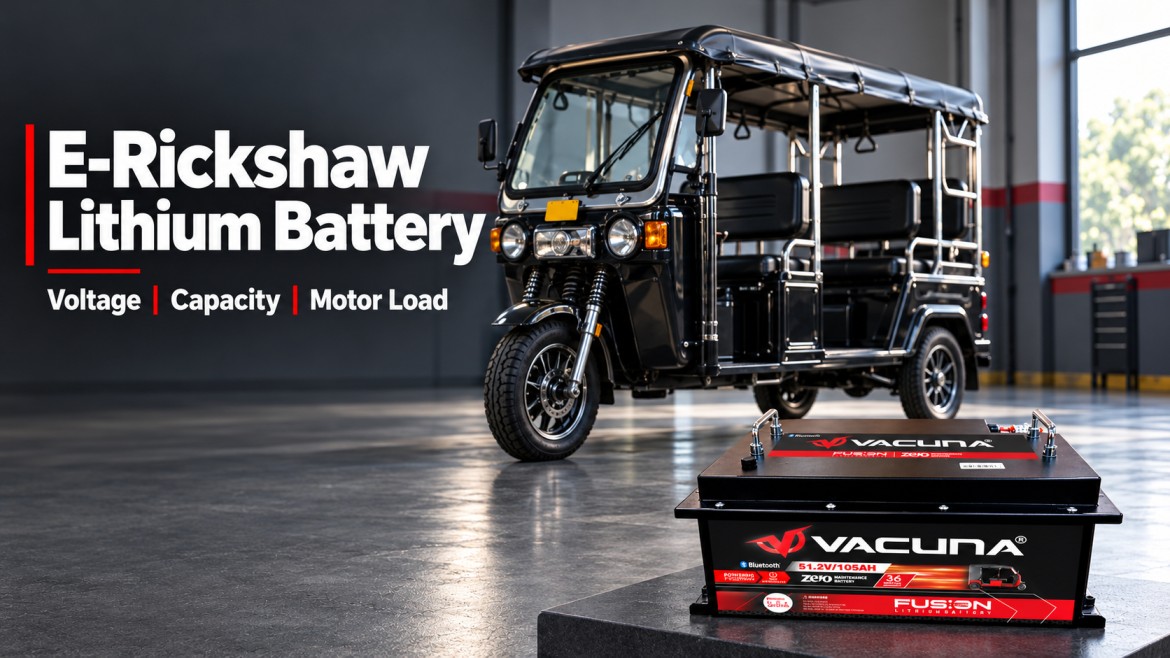
Choosing the right Lithium Ion Battery for E Rickshaw starts with understanding three things: voltage, battery capacity, and motor load. These factors decide the compatibility of the battery with the vehicle as well as the amount of usable energy that the battery can deliver. For motorists and vehicle fleets, matching these specifications will help avoid any such issues.
Why Battery Specifications Matter for E-Rickshaws
The e-rickshaw runs through acceleration, deceleration, and loading of passengers. All these operations influence the electricity utilization.
The battery should provide enough energy without violating the electricity parameters. Even when a high-energy battery is used, if its voltage and discharge do not meet the requirements of the vehicle, it will function badly.
Thus, it is very important to understand all the details before buying a battery.
Understanding E-Rickshaw Battery Voltage
The voltage sets the compatibility of the power system with the battery and the controller.
There are different types of battery systems for e-rickshaws. The systems can be divided into two groups: 48V and 60V. Batteries like LiFePO4 batteries can have rated voltages of 51.2V or 60.8V.
Why Voltage Matching Is Important
Use of a battery that does not have the right voltage may lead to damage of electrical parts in the car or even make the car run poorly.
It is important to consider:
- Vehicle operating voltage
- Voltage range of motor controller
- Battery charging voltage
- Compatibility of battery management system
One should never think that use of a high-voltage battery improves the performance of the vehicle.
How Battery Capacity Affects Daily Operations
Capacity, given in ampere-hours (Ah), refers to the amount of electricity that a battery can store.
When it comes to Lithium Ion Battery for E Rickshaw, capacity impacts the amount of energy usable for driving.
Nevertheless, it is important to understand that comparing Ah can be incorrect when the voltage of batteries differs.
Understanding Battery Energy in kWh
Battery energy can be estimated using:
Energy (kWh) = Voltage × Capacity (Ah) ÷ 1000
For example:
| Battery Rating | Nominal Energy |
| 51.2V 100Ah | 5.12 kWh |
| 51.2V 120Ah | 6.14 kWh |
| 60.8V 100Ah | 6.08 kWh |
This energy is nominal stored energy rather than assured driving range.
Usable energy is determined by battery operational constraints, temperature, and discharge parameters.
Understanding Motor Load Requirements
An electric rickshaw motor requires power depending on the condition of driving. Weight of passengers, gradients of roads, number of halts, and acceleration may affect that.
A Li-ion Battery for E Rickshaw should cater to continuous as well as peak currents.
Check the Battery Discharge Rating
Consider a vehicle drawing 1,500W from a 51.2V battery.
The approximate battery current is:
Current = 1500 ÷ 51.2 = 29.3A
Actual current depends on voltage and efficiency. Acceleration will need significantly more current.
Review the battery’s continuous discharge rating and maximum peak current capacity before installing it.
Why Battery Management Systems Matter
A Battery Management System (BMS) checks certain critical operating parameters of a lithium battery.
These may vary depending upon the configuration of the BMS and include:
- Overcharging protection
- Over-discharging protection
- Short circuit protection
- Temperature checking
- Overcurrent protection
- Cell balancing
But even a good BMS cannot make up for a wrongly specified motor controller and incompatible charger.
How to Select the Right Battery
While buying an electric rickshaw battery, make sure you first verify the specifications of your vehicle and its daily usage.
Select a battery after ensuring compatibility in voltage, energy, discharge current, charging parameters, dimensions, and warranty.
Vacuna provides solutions in batteries for electric mobility applications. Prospective buyers can refer to Vacuna Batteries to get details about their current product range.
Frequently Asked Questions
1. Which Voltage Is Suitable for an E-Rickshaw Lithium Battery?
It depends on the vehicle’s electrical design. Common systems include 48V-class and 60V-class configurations. Always verify the motor controller’s supported voltage range.
2. Is a 100Ah Lithium Battery Enough for an E-Rickshaw?
It may be sufficient for some applications, but daily distance, passenger load, voltage, and energy consumption determine suitability.
3. Does Higher Battery Capacity Increase Driving Range?
Generally, higher usable energy can extend range under similar conditions. Actual results depend on vehicle efficiency, terrain, load, and driving behaviour.
4. Can a Lithium Battery Replace a Lead-Acid Battery?
Yes, in compatible systems. However, voltage, controller limits, charging equipment, mounting, and electrical protection must be checked before replacement.
5. Why Is BMS Important in an E-Rickshaw Battery?
A BMS monitors battery conditions and helps protect against excessive current, voltage problems, and unsafe temperatures.
6. How Do I Choose the Right Lithium Battery for My E-Rickshaw?
Check the vehicle’s rated voltage, motor power, daily distance, battery capacity, discharge current, and charger compatibility. Seek professional guidance before installation.
Conclusion
Choosing the proper Lithium Ion Battery for E Rickshaw is more than just choosing the battery with higher Ah. There are many factors to consider for smooth functioning.
Explore Vacuna’s battery solutions and contact the team to discuss a suitable battery configuration for your e-rickshaw requirements.