“Kitna range deti hai?”
This is generally the first question that comes to mind when purchasing a battery for an e-rickshaw. It makes perfect sense.
Range means more to a driver than just a number. Range translates into distance covered, rides taken, stops required, and earnings. When the range is higher, the driver can earn more. With reduced range, the vehicle remains stationary at the charge point while other vehicles continue to work. But then, there is one point which the majority of purchasers fail to comprehend.
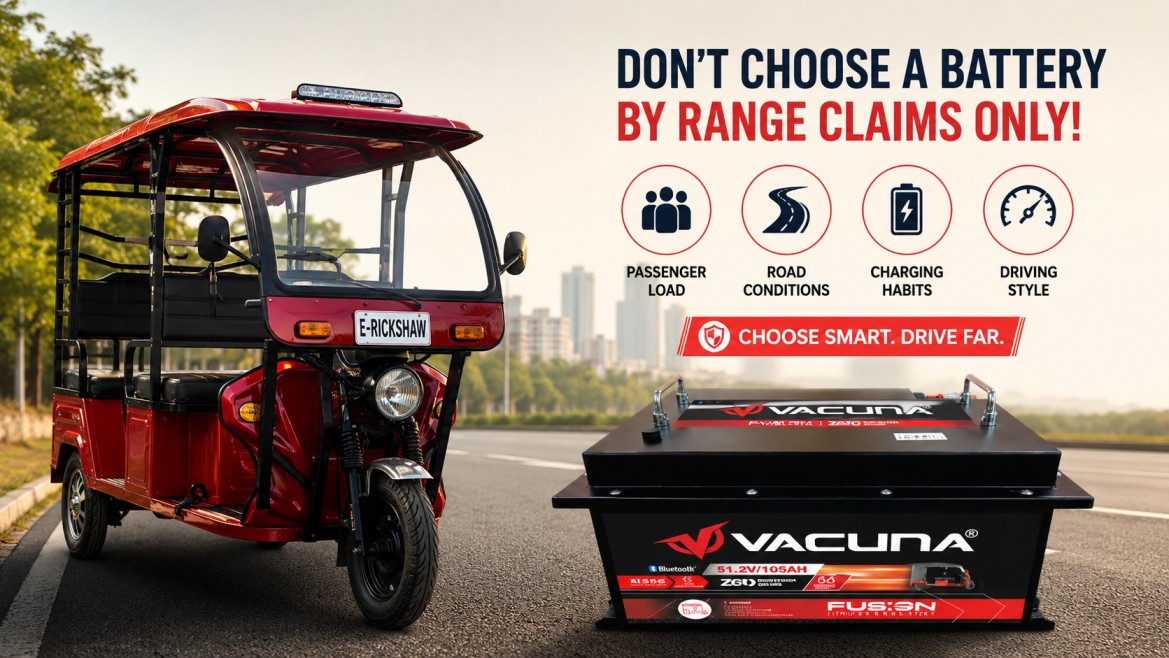
There is no direct correlation between advertised range and actual road usage. A battery may perform well on paper with regard to range. However, the actual riding experience is entirely different. The range varies depending on the passenger load, road condition, speed of travel, charging pattern, tyre pressure, and even weather conditions.
It is important, therefore, not to select the Lithium Battery for E Rickshaw based on the range figure alone..
Range Depends On Passenger Load
An e-rickshaw is not left without passengers throughout the day.
They travel with passengers, school bags, grocery, luggage, and even sometimes overload at peak hours. More load requires more energy from the motor. Thus, the battery gets drained quickly. This is the reason why two drivers using the same battery can have a different experience. One can travel for short distances locally with low load.
Whereas the other one will travel with overloaded passengers in rush hour routes. Therefore, before purchasing a Lithium Battery for E Rickshaw, the driver should consider the load rather than the range mentioned in the brochures.
Route Conditions Change Battery Backup
Roads play an important part as well. The use of battery is easier when the path taken by the colony is even. However, roads that are rough and bumpy, have a slope, and frequent stops are more demanding for the vehicle.
Every halt and acceleration draws energy from the battery. Whereas in city streets, an e-rickshaw has to halt quite often, in such cases the battery has to perform more than what it does in an easy path outside.
That’s why the range always has to be calculated in terms of the road taken. A driver who is working close to marketplaces, railway stations, schools, and bus stands will require more battery planning than the one working on local roads.
Speed And Driving Style Matter
Drive style also impacts range. Rapid acceleration uses up more energy. Sudden stopping means wasting the momentum gained. Driving the car hard reduces the backup more quickly. A gentle driver can achieve more range using the same battery.
But that does not imply that the driver should be slow always. Consistent hard driving will affect the outcome on a daily basis. Thus, when a battery marketer promises “this much range,” the driver needs to ask:
“What type of load and route?”
Tyre Pressure Is A Small Thing, But It Matters
Many drivers neglect their tyre pressure. If tyres are under pressure, the vehicle becomes difficult to drive. Engine has to work extra hard, and also, the battery gets exhausted very quickly.
This does not seem like an important point at the beginning, but through repeated use throughout the day, it causes reduction in back up. The same is true about the wheels alignment, breaks, and overall conditions of the vehicle.
An efficient Lithium Ion Battery for E Rickshaw can function effectively only if the rest of the vehicle is well-maintained as well. If there is any sort of drag or technical difficulty within the vehicle, battery will become inefficient.
Charging Habits Affect Daily Range
Another frequent cause of range issues is charging problems. Some people charge the battery only partially. Some use an inappropriate charger. Some people charge it using weak power sockets. Some restart charging before the battery regains its strength.
The battery does not seem to provide adequate range. In actuality, the battery does not start the day fully charged.
It is very crucial for a Lithium Battery for E Rickshaw that the charger be compatible. A good battery needs appropriate charging.
Weather And Heat Also Play A Role
The weather conditions of India can play havoc with the battery life. Heat and heavy use along with frequent charging may cause some effects on the battery performance.
During summers, both the temperature of the battery and the load of the vehicle can go up. This may decrease the distance that a person would have expected to travel. This is why a person should not make a comparison of the winter and summer performance without thinking.
Range Is Important, But It Is Not The Only Thing
Range matters. No doubt.
But it should not be the only deciding point.
Drivers should also check:
- Battery chemistry
- Battery capacity
- Charging time
- Charger compatibility
- BMS protection
- Service support
- Warranty terms
- Vehicle compatibility
- Daily load requirement
The issue with a battery having high range and low support is that it causes problems in the future. Matching a battery with good servicing could be more beneficial.
Battery Selection at Vacuna Battery selection must begin by considering the practical applications at Vacuna. The person driving an e-rickshaw would require a battery suited to his route and earnings.
Why Vacuna Focuses On Practical Battery Selection
Each e-rickshaw driver follows his own work cycle. Some e-rickshaws ply their trade close to metro stations. Some have school runs. Some ferry customers from the market area. Some e-rickshaws are used for most part of the day while others are used only during peak periods. The power requirements for these drivers are different from each other.
This is the reason why Vacuna goes beyond just one number on its range. It is time to choose Lithium Batteries for E Rickshaw which suit the driver’s actual route. Proper battery planning can save you a lot of worries.
Final Thoughts
The e-rickshaw operators must consider the range of the vehicle. However, they shouldn’t just limit themselves to that.
The range is dependent on the passenger weight, road condition, speed, tyre pressure, charging frequency, condition of the vehicle, and climatic conditions. Range alone may not tell the whole story. The correct Lithium Battery for E Rickshaw is one which suits the driving needs of the individual.
This is because when it comes to the e-rickshaw operator, the question that really counts isn’t,
“Can it drive that far?”
The question is,
“Will it support my journey?”
Frequently Asked Questions
1. Why Does E-Rickshaw Battery Range Change In Daily Use?
E-rickshaw battery range changes because of passenger load, road condition, speed, tyre pressure, weather, charging habits, and vehicle condition.
2. Is Range The Most Important Factor When Buying An E-Rickshaw Battery?
Range is important, but it is not the only factor. Drivers should also check charging time, BMS safety, warranty, service support, and vehicle compatibility.
3. Why Does A Lithium Battery For E Rickshaw Give Different Range To Different Drivers?
Different drivers carry different loads, drive on different routes, and follow different charging habits. That is why the same battery may give different results.
4. Can Poor Tyre Pressure Reduce E-Rickshaw Battery Backup?
Yes. Low tyre pressure increases rolling resistance. This makes the motor work harder and drains the battery faster.
5. Does Charging Habit Affect Lithium Ion Battery For E Rickshaw Performance?
Yes. Incomplete charging, wrong charger use, weak power supply, and frequent deep discharge can affect daily range and long-term battery performance.
6. How Should A Driver Choose The Right E-Rickshaw Battery?
A driver should check daily route, passenger load, charging time, battery capacity, charger compatibility, service support, and warranty before choosing a battery.