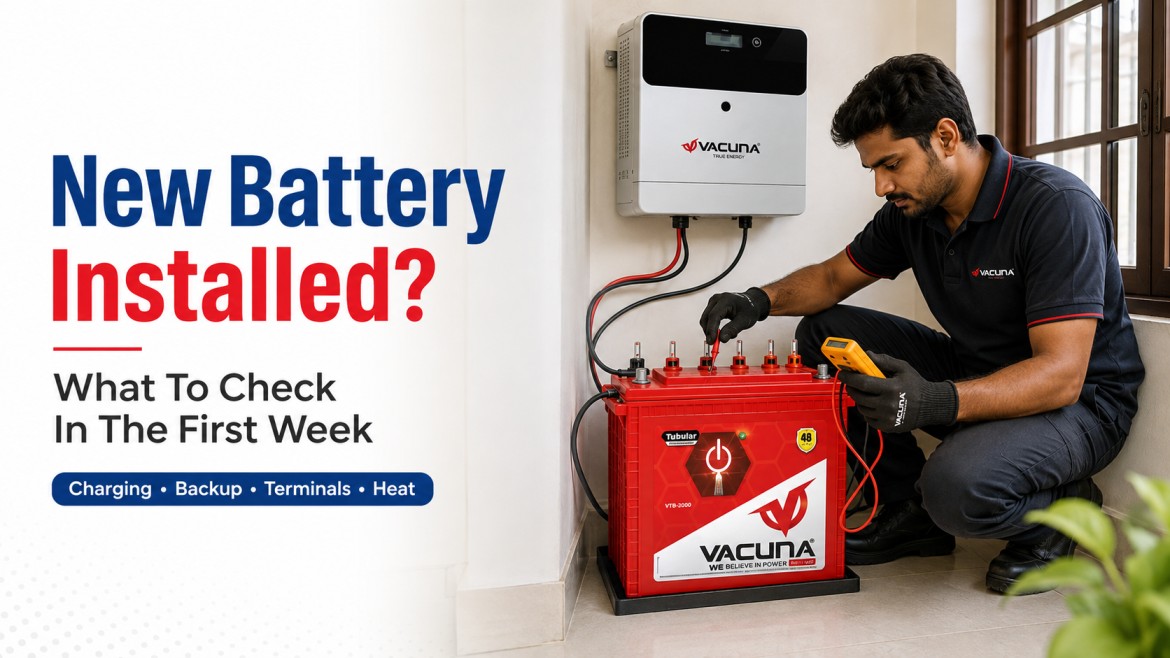
What Happens In The First Week After A New Battery Is Installed?

The performance of the new battery is normally assessed within the first 24 hours. There is power generation by the inverter, the car starts, or there is backup, everything seems all right. However, the first week is an indication of whether the battery, charger, wiring, and the load are working properly together. A reputable Battery Manufacturer in India would consider not just the ability of the battery to supply power to the system but also charging behavior, backup period, terminals, heat, and daily use as well.

Day One: Check The Installation First

The first test is pretty straightforward – did the battery install well?

All terminals must be clean and tight. The cables must not be loose, and the battery must be tightly secured in its designated position. For an Inverter Battery, it must also be dry and ventilated well.

No matter how healthy the battery is, it may underperform due to loose connection. This is the reason why installation is to be tested before making any conclusions regarding its performance.

For an Automotive Battery, the terminals must not move while the car is going through the rough road.

Watch How The Battery Charges

What follows this is charging.

When using inverters, check the time taken to recharge the battery after the power failure. If you find that the time taken is very long, then the problem could be in the settings of the inverter, the charger, the wiring, or lack of sufficient electricity from the mains.

In case of an inverter battery, a new one needs to be installed with the appropriate inverter. Increasing the battery will not do any good if the inverter cannot charge the battery effectively.

Similar concept applies in case of automotive batteries. Here, the automotive battery relies on the charging system of the vehicle. The alternator should be strong enough to charge the battery.

A responsible battery manufacturer in India looks at charging as part of the entire system.

Do Not Judge Backup From One Power Cut

An evening’s worth of backup is insufficient for assessing the performance of a new battery.

Consider an initial outage of 30 minutes where the house was running two fans and three lights. On the second day, there is an outage lasting three hours, with the TV, Wi-Fi connection, laptop and additional fans working.

It is clear that the experience of the backup would vary.

It is necessary to keep track of the load and backup time for the first week. Ideally, it should be possible to know what appliances were being used at the time of each outage. It provides a more helpful insight than merely stating, “The battery has a reduced backup time today.”

A reputable Battery Manufacturer in India should guide their customers to understand that the backup depends on the load and the charge level.

Pay Attention To Unusual Heat

Some heating during charging or heavy usage is possible. Nonetheless, any abnormal heating should never be overlooked.

It is necessary to determine whether the battery, the cables, or the terminals have become considerably overheated. Overheating could be an indicator of loose connections, improper charging conditions, overload, or even some other system failure.

Trying to resolve this issue through setting adjustments without any professional advice would only lead to complications.

In particular, this step needs to be taken during the first week since early detection of a minor installation problem could help to prevent future complaints.

Look At The Terminals Again After A Few Days

Although everything may seem perfectly installed on the first day, it is important to check it several days later.

Movements, vibrations, or the fact that some connections were loose at first may only become obvious after use. In the case of Automotive Battery, vibration caused by the road makes it especially important. If this is a home backup system, make sure that the cables have not become loose and dirty.

Any corrosion, loose cables, swelling, odd smells, or frequent charging errors should be reported to the installer.

Has Your Actual Load Matched What You Planned?

This is often where most new-battery complaints start from.

The buyer purchases an Inverter Battery which was supposed to be capable of running four lights and two fans. Now, after installation, the family begins using Wi-Fi, television, CCTV cameras, laptops and many chargers in each power cut.

The battery is now being asked to do a lot more than what it was meant to do in the first place.

But before coming to a conclusion about how bad the backup has been, the comparison has to be done between the load that has been experienced and the load mentioned at the time of purchase.

What Vacuna Recommends During The First Week

At Vacuna, we feel that the first week should be devoted to analyzing the entire setup.

Observe how the battery charges. See what happens when backup is done under regular load. Test the terminals and the installation area. Note any unusual heating or message warnings. In addition, ensure that the inverter or car charging system is functioning correctly too.

New batteries don’t require constant care. However, the above tests will help determine if the battery and the rest of the system complement each other.

As a Battery Manufacturer in India, Vacuna gives importance to applications, compatibility, and actual performance more than battery capacity alone.

Final Thoughts

The first day just tells you if the new battery functions properly.

The first week will tell you much more.

Battery charging time, battery backup, battery terminals, heating, load, and inverter or vehicle compatibility all give indications of whether the installation is correct. If anything seems strange, always test the entire system first before concluding that there is a problem with the new battery.

An effective battery always requires an effective setup.

Frequently Asked Questions

1. Should A New Battery Give Full Backup From Day One?

It should work correctly after proper installation, but actual backup depends on charge level, connected load, inverter compatibility, and usage conditions.

2. Why Is My New Inverter Battery Charging Slowly?

Possible reasons include low charger output, inverter settings, loose cables, limited grid time, or an unsuitable battery-inverter combination.

3. Is Heating Normal In A New Battery?

Mild warmth can occur during charging or heavy use. Unusual or excessive heat should be inspected.

4. Why Does My New Battery Give Different Backup Each Day?

The load, charging time, outage duration, and starting charge level may be different each day.

5. What Should I Check In A New Automotive Battery?

Check terminal tightness, mounting, starting performance, charging-system health, and any unusual warning signs.

6. Why Choose Vacuna As A Battery Manufacturer In India?

Vacuna focuses on matching the battery with the application, charging system, load, installation conditions, and real backup needs.
Your Battery Setup Was Right Three Years Ago. Is It Still Right Today?

While a Battery Manufacturer in India would offer you a backup solution that completely suits your requirements during the purchase process, it is a fact that neither domestic nor commercial establishments consume electrical energy at the same rate continuously. With passage of time in around three years, a couple of additions in appliances, increased operating time, or different power cut patterns can increase the consumption level without any change in the battery and inverter.

This is why there comes a situation wherein the existing arrangement starts becoming insufficient despite the battery remaining in good condition.

Your Daily Power Use May Have Increased

Consider what you had at home or in your office three years back.

Maybe you had the inverter to support two fans, some lighting, and a television. In the meantime, you could have added Wi-Fi, CCTV camera, laptop, additional TV, mobile charging, or working-from-home devices.

Each of these devices uses only little energy; but taken together, they affect the total load.

This also applies to businesses. A small retail outlet might add billing systems, CCTV, additional lights, computers, printers, and internet-related stuff. Working hours might also be extended.

Inverter Battery purchased for the old load will not give as much backup time because the load has increased.

Backup Time Changes When The Load Changes

Battery backup has a lot to do with how much electricity is currently being consumed.

This means that while one day you had a setup of two fans and four lights running for many hours, today the same system is powering those appliances in addition to Wi-Fi, CCTV, your laptop computer and the TV set.

The battery has not necessarily lost efficiency. What has happened is that the energy stored within is being depleted more quickly.

The right Battery Manufacturer in India ought to analyze the present electrical load before suggesting battery change.

Do not make the mistake of replacing the battery without comparing your present consumption with that of the past.

Power-Cut Patterns Can Change Too

Your appliances might not be the only thing that changed.

A backup solution might have been chosen when the duration of local outages was 30 minutes. Should the duration of power outages be two or three hours now, then the same battery won’t seem as appropriate.

Frequent shorter outages might lead to yet another issue. The battery might not have enough time to charge before the electricity fails again.

In such an instance, the following outage starts with less energy stored in the battery.

That is why a good Battery Manufacturer in India should take into account both backup duration and charging duration.

Has The Inverter Kept Up With The Battery?

The battery and the inverter should always be considered as a single system.

In case the load on the home is bigger than before, the inverter should also be capable of handling it. Overloaded inverter can produce beeps, switch off, and work poorly in the process of simultaneous functioning of several home appliances.

Charging capacity is also important.

Assuming that you upgrade your old battery with a new Inverter Battery of greater capacity, the inverter itself could have insufficient charging capacity, thus making the charging process very slow.

That means that upgrading of battery capacity may not be enough for solving the initial issue.

It is particularly true about Lithium Battery for Inverter.

When Should You Review Your Battery Setup?

You don’t have to re-design the system every year. But a review is warranted if there has been an observable change in your consumption pattern.

  • Consider reviewing the configuration if:
  • You have brought in a few more gadgets
  • Wi-Fi and CCTV systems require constant backup
  • Somebody is working from home
  • Your operating hours have increased
  • There are longer or frequent power outages

There is reduced backup duration despite the battery performing well in the test

The inverter throws up an overload or charging alert

This might tell you much more than just how old the battery is.

Vacuna’s Approach To Changing Power Needs

At Vacuna, selection of batteries is based on the application itself.

The required capacity of the battery will depend on the load, the inverter, the charging condition, and the backup duration that is expected. This must be analyzed if there are changes in the power consumption pattern of the home or business establishment.

As a Battery Manufacturer in India, Vacuna concentrates on matching the batteries to the actual conditions of use and not considering battery capacity as the solution.

In some cases, the existing battery setup may require only load optimization and installation analysis. Some may really require an increased battery capacity.

A Lithium Battery for Inverter is another option that can be looked at.

Final Thoughts

A battery installation that worked three years ago need not be faulty now.

An increase in devices, more outages, heavy load, and change in work practices are among the reasons why the level of backup received is reduced.

Before getting rid of the battery, have the entire system analyzed.

A reputable Battery Manufacturer in India should take into account the battery, the inverter, charger, the load, and the power outage cycle as a whole.

The appropriate backup system is not one that worked for your home three years ago.

Frequently Asked Questions

1. Why Has My Battery Backup Reduced Over The Years?

Your battery may have aged, but your load may also have increased due to additional fans, TVs, Wi-Fi, CCTV, laptops, and other devices.

2. Should I Replace My Inverter Battery If Backup Drops?

Not immediately. First check the battery condition, connected load, inverter settings, wiring, and charging time.

3. Can Adding CCTV And Wi-Fi Affect Backup Time?

Yes. These devices consume power continuously and increase the total load during an outage.

4. Does A Bigger Inverter Battery Always Solve Low Backup?

No. The inverter must also support and recharge the larger battery correctly.

5. When Is A Lithium Battery For Inverter Worth Considering?

It may be suitable when the required capacity, charging conditions, inverter compatibility, usage pattern, and expected backup support lithium technology.

6. Why Choose Vacuna As A Battery Manufacturer In India?

Vacuna focuses on matching battery capacity with the user’s actual load, inverter setup, charging conditions, and changing backup needs.

The Battery Is Fine. So Why Does The Backup Keep Changing Every Day?

The Batteries of a Manufacturer in India may have supplied the same battery model to many households, but the backup experience may differ from one day to another. One day, the battery may efficiently provide backup to fans, lighting, and Wi-Fi service. But on the other day, the low battery alert comes on sooner.

This may not necessarily indicate any problem with the battery.

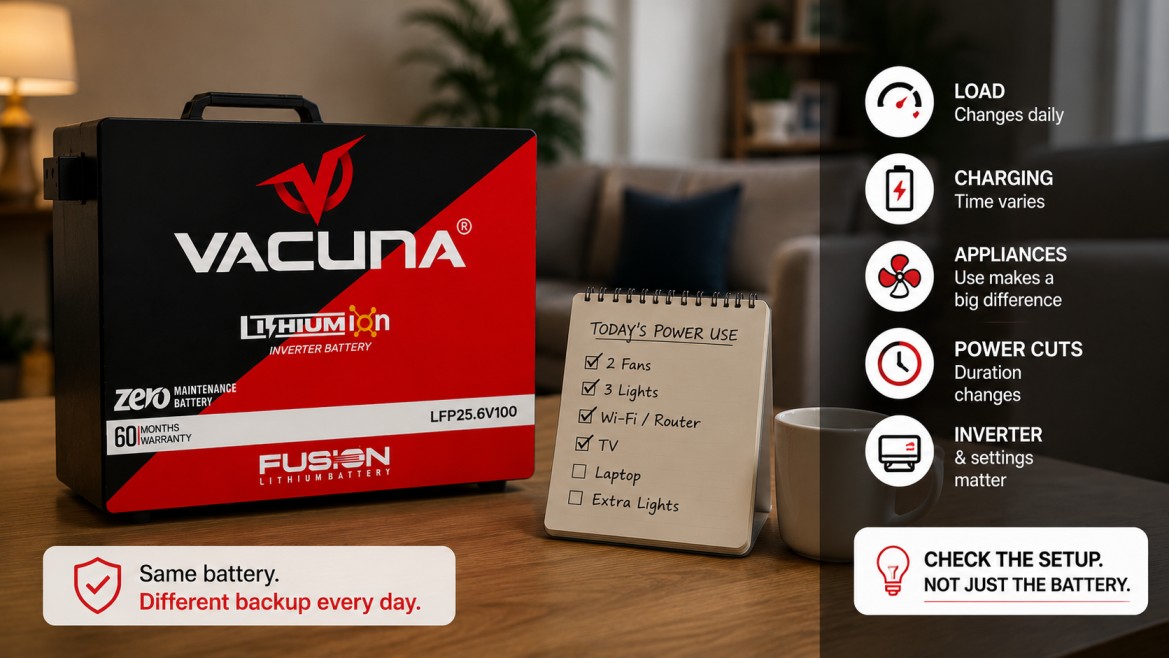
The reasons for differences in backup lie in the changing environmental factors surrounding the battery. Daily load, charging duration, appliances usage, power cut duration, and even the duration of time between two power cuts may influence the outcome.

Your Home Load Is Not The Same Every Day

The major factor that determines the need to change backup comes from the load.

During one day, the usage of two fans, three lights, and Wi-Fi while there is no power supply is done.

But on some other day, the usage of TV, laptop, CCTVs, mobile charging, and additional lights may be done.

Thus, the amount of energy being provided by the battery increases.

It is expected that backup will run out earlier than before.

That is why it is always known that a good Battery Manufacturer in India would never say that backup is always a constant value.

It depends entirely on the load being used at that time..

Charging Time Changes The Starting Point

Backup is also based on the state of charge the battery had before the power failed.

Let us imagine that there is a power failure lasting two hours in the afternoon. Then, the power comes back on for one hour only and another power failure starts in the evening.

The battery may lack time to recharge after losing its charge during the first power failure.

Thus, the next power failure will start with less charge in the battery. The user will think that the battery started giving poor backup, but in reality, it did not recharge completely.

This problem becomes widespread in regions with frequent power failures.

For the Lithium Battery for Inverter, it will be easy to deal with partial charging. But if the battery is frequently charged for less time than it is required, the amount of backup will differ from time to time.

Appliance Use Matters More Than Most People Think

Small electrical appliances matter a lot.

A router, CCTV system, TV set, laptop, and multiple mobile phone chargers might not appear to be major consumers of power alone. However, in combination, their consumption will be significantly higher.

The fan speed and the number of additional lights in use during the power failure also play a role.

Thus, two households using the identical inverter battery will have substantially different power backup. Even one household will experience different power backup on two different days.

A real Battery Manufacturer in India would be doing its part in informing the consumer about this issue before comparing the power backup according to the capacity of the battery.

Longer Power Cuts Change The Experience

Duration of power-cut also influences how individuals perceive the battery’s performance.

If all power cuts are 30 minutes long, the battery will always seem powerful as not much energy is consumed. But then suddenly, there is no electricity for three hours.

This means that the battery is now powering the house longer than usual.

As the backup is done sooner than expected, the individual thinks that there might be some problem. Actually, it is possible that the battery was working harder than usual.

This is the reason why battery backup needs to be compared under the same conditions.

It does not make sense to compare a 3-hour power cut with a 30-minute one under the same expectations.

The Inverter And Charging Setup Also Matter

Battery does not function in isolation.

The inverter controls how the battery charges and how the electricity flows to the appliances attached to it. Improper settings, slow charging, poor connections or cables will impact everyday functioning.

Before replacement of inverter battery, one should check:

  • Charging voltage and current
  • Inverter settings
  • Condition of cables and terminals
  • Charging time available
  • Load
  • Power cut pattern

Lithium Battery for Inverter has to be compatible with inverter and charger for it to function properly.

Why Vacuna Looks At The Complete Setup

We at Vacuna believe that the performance of the battery should always be evaluated based on the entire power backup system.

All these elements function together as one unit and if any element changes, it will affect the experience of using the backup system as well.

As Battery Manufacturers in India, our motto is to evaluate the application of the battery first before making an assumption of battery failure based on poor backup performance.

A new battery may not be the solution; it may just be about reducing loads or improving charging times and inverter settings.

Final Thoughts

The daily battery backup will not be the same as the power usage in the house will not always be the same each day.

Load is variable. Time for charging is also different. Power outages may get longer or more frequent. Appliances are left plugged in even during the outages.

So, before pointing to the battery, one should consider what is different around the battery.

The design of an efficient battery backup system requires much more than just selecting the right battery.

Frequently Asked Questions

1. Why Does My Battery Give Different Backup Every Day?

Daily load, charging time, appliance use, and power-cut duration may change. These factors directly affect backup time.

2. Does Lower Backup Always Mean The Battery Is Weak?

No. The battery may be partly charged, carrying a higher load, or facing longer outages than usual.

3. Can Frequent Power Cuts Reduce Backup?

Yes. Repeated outages may leave less time for the battery to recharge before the next cut.

4. Does A Lithium Battery For Inverter Need Full Charging Every Time?

Not always. Lithium batteries generally handle partial charging well, but they still need enough stored energy for the next expected backup period.

5. Can Extra Appliances Reduce Inverter Battery Backup?

Yes. TVs, laptops, CCTV, routers, extra fans, and chargers all increase the load and reduce available backup time.

6. Why Choose Vacuna As A Battery Manufacturer In India?

Vacuna focuses on matching battery solutions with real load, charging conditions, inverter compatibility, and everyday backup requirements.

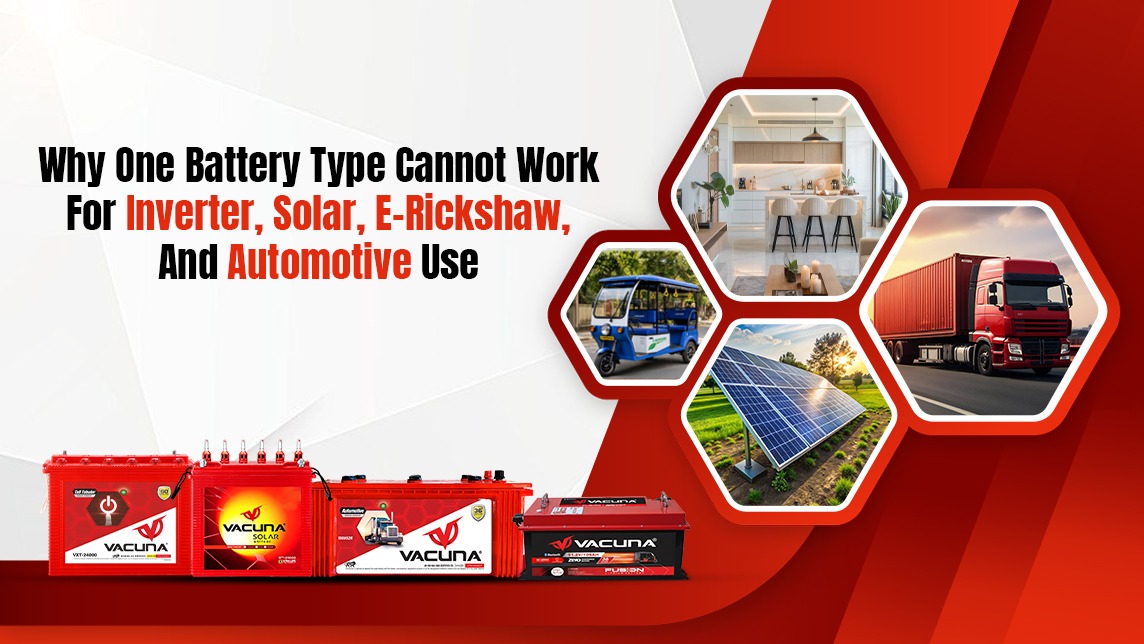
Why One Battery Type Cannot Work For Inverter, Solar, E-Rickshaw, And Automotive Use

The common perception among many purchasers is that a battery is a battery; if the battery’s voltage and dimensions seem fine, it will be fine everywhere else as well. This is far from how the battery operates in practice.

The battery required for inverter power backup will operate under different loads than the battery powering an e-rickshaw. The battery for a solar panel works differently from the battery for automotive purposes. A lithium inverter battery is not chosen the same way a normal lead acid battery would be.

This is where the importance of a good battery manufacturer in India comes in. It needs to take into consideration how and where the battery will be used, rather than recommend a battery for everything. At Vacuna, the battery selection process begins with a single simple question – “Where?”

Inverter Batteries Need Stable Backup

In the event of power failures, the inverter battery must cater to the needs of houses, commercial establishments, offices, small business organizations, and so forth. There can be any number of electrical equipment that would be running from the battery, including fans, lights, WiFi, cameras, computers, billing software, etc. There is a need to have the battery cater to the backup needs as well as getting recharged whenever there is a sudden availability of electrical current in sufficient quantities. If the battery is not adequate, the battery keeps discharging continuously.

Lithium-ion batteries for inverter make perfect sense if one wants efficient charging, minimum maintenance, and backups. But even then, the choice of lithium batteries will depend upon several other considerations as well.

Solar Batteries Work In Daily Cycles

The task of solar batteries is quite different from other types of batteries. They charge during daytime and discharge when the stored electricity is used at night. Such a daily cycle implies that a solar battery must have high charge acceptability and ability to work in cycles. It is important to consider such factors as appropriate sizing of solar batteries as well.

If the battery does not suit solar power systems, then no matter how efficiently the panels work, there will be issues with backup loss, charging inconsistencies, and the entire solar power system will be to blame. It is important to provide customers with a reliable Solar Battery Supplier In UP, which will ensure compatibility between battery capacity, inverter, loads, and backup requirements. Solar power systems are not only about panels but also about battery performance.

E-Rickshaw Batteries Need Running Strength

The battery of an e-rickshaw is like a financial partner to the owner. This is because the battery will transport people, will carry load on the road, will frequently stop and start, and will run for many hours. Failure to use a secondary battery means loss of money from lost transportation while excessive charging time means wastage of working hours.

The battery which performs well in the case of home power cannot simply be adopted to serve the purpose of an e-rickshaw battery. There are many factors that come into play. These include passenger load, road conditions, how the battery is charged, and working hours.

Automotive Batteries Need Starting Power

The other purpose of the automotive batteries is that they must be capable of producing a high surge of energy for the purpose of engine start up. This means that it is not the same as providing extended backup like the inverter battery. Vehicles, especially cars, trucks, commercial vehicles etc. are exposed to various conditions such as heat, vibrations, short drives, prolonged time in parks and frequent engine starts.

An important aspect for an Automotive Battery Manufacturer In Meerut would be the emphasis on cranking power, packaging, terminal configuration, longevity and vehicle suitability. The automotive battery cannot be compared with the solar or inverter battery because of its basic function of starting.

Why Application-Based Selection Matters

Improper choice of the battery leads to problems in future.

The solar customer might encounter problems related to lack of backup.

The inverter consumer may experience battery discharging issues.

The e-rickshaw owner will face issues related to insufficient run time.

The car owner may encounter problems related to start-up difficulties.

However, the issue does not always relate to battery quality alone. It can result from selecting the wrong type of battery for the wrong application. That’s why dealing with a well-informed Battery Supplier In India becomes necessary.

Final Thoughts

No single battery can meet all needs. Inverter batteries need consistent backup. Solar batteries require deep cycles. E-rickshaw batteries require good daily operation. Automotive batteries need good cranking capability. All four have different roles.

At Vacuna, our view is that choosing the correct battery should be rational rather than random. The battery chosen needs to match the usage intended for it in reality. This distinction separates those batteries which only fit into the required space from those that actually deliver good performance.

5 Things You Didn’t Know About Lithium Inverter Batteries for Your Home or Business

Most people do not think much about the inverter battery when everything is working fine.

The fan runs. Lights stay on. Wi-Fi does not drop. Shop billing continues. Office systems stay active. So nobody checks what is happening inside the battery. The problem starts when backup slowly drops.

Earlier the inverter used to run for a decent time. Then slowly it starts giving less backup. The inverter beeps early. The fan speed feels weak during a power cut. In shops or offices, the staff starts complaining because systems shut down before expected. Then someone finally checks the battery and says, “Battery weak ho gayi hai.”

That is usually when people start looking for a better option.

This is where Lithium Inverter Batteries are getting attention. Not because they are new or fancy, but because regular lead-acid batteries create repeated problems in many homes and businesses, especially where power cuts are common.

Vacuna works in this backup power space, so let’s keep this practical. Before choosing a lithium battery for inverter backup, these are five things most buyers should understand properly.

1. The Real Saving Is Not Only In Power. It Is In Fewer Battery Changes.

Most people compare batteries only by first price.

Lead-acid battery looks cheaper. Lithium battery looks costly. So the decision feels easy.

But that is not the full picture.

In real use, inverter battery cost continues after purchase. A normal lead-acid battery may work fine in the beginning, but after some years, backup starts reducing. This happens faster if the battery is kept in a hot place, used heavily, charged incorrectly, or not maintained properly.

The problem is not always sudden failure. Many times the battery slowly becomes weak.

First, backup reduces by 10–15 minutes. Then charging takes longer. Then the inverter starts giving low battery warning earlier than before. In some cases, the battery heats up or terminals get corroded. By the time the user notices properly, the battery is already near replacement.

A lithium battery for inverter use generally gives a longer working life when it is matched with the right inverter and installed properly. So instead of replacing the battery again and again, the user gets a longer service cycle.

For a home, this means fewer battery-change headaches.

For a business, it matters even more. A shop cannot keep billing stopped during a power cut. A clinic cannot let equipment or lights go down suddenly. An office cannot keep losing Wi-Fi, computers, and basic lighting every time backup fails.

So the saving is not only in battery cost. It is also in avoiding repeated disturbance.

2. Fast Charging Sounds Simple, But It Matters Most During Repeated Power Cuts.

A lot of people hear “fast charging” and think it is just another feature. But in actual use, fast charging only matters in certain conditions. If your area has one power cut in a day and then the electricity stays stable, charging speed may not be a very big issue. The battery gets enough time to recover. But many places do not get power cuts like that.

In some areas, power goes for two hours, comes back for one hour, then goes again. In commercial areas, voltage fluctuation and short outages can also happen. This is where traditional batteries struggle because they may not get enough time to charge back properly before the next cut.

A lithium-ion inverter battery can recharge faster compared to many old-style battery setups. That means the battery is better prepared when the next power cut comes.

This helps in places where backup is used daily: shops, clinics, small offices, CCTV rooms, billing counters, server corners, and homes where people work online.

But one thing should be clear. Fast charging only works properly when the inverter and charging system support the battery correctly. If the inverter is not suitable, you will not get the full benefit. That is why compatibility checking is important before shifting to lithium.

3. Low Maintenance Does Not Mean Careless Installation.

This is one of the biggest misunderstandings. Yes, lithium batteries need less maintenance than lead-acid batteries.

There is no water topping. No acid leakage issue. No regular terminal cleaning like many old battery setups. No heavy smell or corrosion problem if the setup is done properly. That is a real advantage.

But it does not mean the battery can be installed anywhere and forgotten.

Inverter batteries still need proper wiring, correct load calculation, safe placement, and suitable charging. Heat still matters. Overload still matters. Loose wiring still creates problems. Wrong inverter matching can still affect performance.

Vacuna’s Lithium Inverter Batteries come with battery protection features like BMS, which stands for Battery Management System. The BMS helps monitor charging, discharging, temperature, and safety limits.

This is important because lithium batteries depend a lot on proper control. A good BMS helps protect the battery from unsafe conditions like overcharging, deep discharge, overheating, or irregular current flow. But even the best BMS cannot fix a bad installation.

If cable size is wrong, load is too high, ventilation is poor, or the inverter charging profile is not suitable, the battery will not perform the way it should.

So the right way is simple: lithium reduces routine maintenance, but the first installation must be done carefully.

4. Size And Weight Make A Bigger Difference Than Buyers Expect.

Anyone who has handled a heavy lead-acid battery knows this already. They are bulky. They are hard to move. They need proper space. In homes, they usually sit in a corner, on a trolley, under stairs, or near the inverter. In shops and offices, they take up floor space that could have been used better.

A lithium backup battery is usually more compact and lighter compared to traditional inverter batteries used for similar backup needs. This makes installation cleaner.

In apartments, it helps because space is already limited. In shops, it keeps the setup from blocking useful area. In offices, clinics, and small commercial sites, it makes wiring and battery placement easier to manage.

Weight also matters during servicing. Moving one heavy battery may not sound like a big deal until you actually have to shift it, replace it, or carry it through a tight staircase.

A cleaner battery setup also reduces mess around the inverter. Less clutter, easier access, better serviceability.

This may sound like a small point, but on actual sites, space always becomes an issue sooner or later.

5. Bms And Battery Chemistry Matter More Than The Label.

Many buyers ask only four things. Price, Ah, voltage, and backup time. That is not enough for lithium. In a lithium battery, the inside quality matters a lot. Battery chemistry, BMS quality, cell matching, protection system, warranty, and service support all decide how the battery will perform in the long run.

A LiFePO4 inverter battery is commonly preferred for backup applications because this chemistry is known for better stability and longer cycle life compared to many other lithium options. But chemistry alone is not enough.

The BMS must be reliable. The battery must match the inverter. The charging current should be suitable. The connected load should be within limit.

This is where cheap lithium batteries can create trouble. On paper, two batteries may look similar. Same voltage. Similar capacity. Similar backup claim. But in actual use, the difference shows later — early cut-off, heating, uneven backup, poor charging response, or weak service support.

That is why buying only by lowest price is risky.

Vacuna’s lithium battery range is made for inverter backup applications where users need stable performance, cleaner installation, and longer service life. But even then, the correct model should be selected based on load, backup requirement, inverter type, and site condition.

Battery selection should not be guesswork.

So, Are Lithium Inverter Batteries Right For Your Home Or Business?

It depends on your usage. If your home has very rare power cuts and you only need short backup for basic lights and fans, a normal battery may still do the job.

But if your inverter is used regularly, backup drops quickly, power cuts happen often, or you are tired of replacing lead-acid batteries every few years, lithium starts making more sense.

For businesses, the decision becomes even clearer. A small office needs Wi-Fi, lights, laptops, and systems running. A clinic needs stable backup for basic operations. A shop needs billing and CCTV working. A commercial setup cannot afford backup failure every few months.

In these cases, Lithium Inverter Batteries are not just a modern option. They are a longer-term backup solution that can reduce repeated battery issues.

The important thing is to choose properly. Check your load. Check backup time. Check inverter compatibility. Check where the battery will be installed. Check whether the current battery is already costing you through maintenance, weak backup, and replacement.

If the old battery setup has become a regular headache, moving to a Vacuna lithium battery for inverter backup can be a practical upgrade. Not because lithium is trendy. Because repeated battery problems cost more than people realise.

From Streets to Storage: How EV Batteries Are Powering India’s Energy Future

Clean energy in India isn’t just about big solar farms or windmills anymore. It’s showing up right on the streets, especially with the rise of e-rickshaws.

But here’s the interesting part. What happens to those batteries once they’re too old to run a vehicle?

Energy today isn’t only about producing power. It’s also about using it smartly. And that’s where things get pretty exciting. Old E Rickshaw Batteries aren’t just thrown away. They’re getting a second life.

The Rise of E-Rickshaws in India

If you step outside in most cities or towns, you’ll see e-rickshaws everywhere. They’ve become a go-to option for short rides because they’re cheap to run, don’t pollute, and are backed by government support.

These vehicles run on batteries, usually lead-acid or lithium-ion.

After about 3 to 5 years, the batteries aren’t strong enough to power a vehicle anymore. But here’s the thing, they still have around 60 to 80 percent of their capacity left. That’s a lot of usable energy going to waste if ignored.

Second-Life Batteries: A Smart Idea

These batteries are instead being utilized for some other purposes.

Such batteries have been named second life batteries. In simple words, these are recycled EV batteries, which can be used for some lesser tasks. Applications include the storage of power in houses, backups for solar panels, or even for smaller businesses to light their premises.

It’s easy to see why this would make sense in a developing nation such as India.

From Vehicles to Homes

At first, these batteries power e-rickshaws. Later, they move into a different role.

They get turned into energy storage batteries and become part of systems that store electricity for homes, businesses, or solar setups.

So instead of ending up as waste, they keep working, just in a different way. And that helps bring down the cost of energy storage too.

Why This Actually Matters

However, this is not simply an economic decision. Second-life batteries make solar energy more practical. They enable storage of excess energy to be used at a later time, for example, at night or when there is no access to electricity.

And in places where electricity isn’t reliable, these systems can make a real difference. People get more steady power without depending fully on the grid.

How It’s Already Happening

This isn’t just an idea. It’s already happening. vacuna

Used EV batteries are being tested and sorted. The ones that still have life left are repurposed and used in storage systems for homes, shops, and solar projects.

It’s slowly becoming part of how the energy system works.

The Challenges

Of course, it’s not all smooth.

There’s still a need for better safety checks, proper systems to collect used batteries, and clear rules around how everything should work.

But things are improving. As more people get on board and technology gets better, these problems are being worked on.

A More Circular Way to Use Batteries

The way we use batteries is changing.

Instead of using them once and throwing them away, we’re starting to use them again in new ways.

E Rickshaw Batteries don’t just stop being useful after their first job. They move on to support homes and renewable energy systems.

And looking ahead, they’re going to play an even bigger role in how India powers itself.

Conclusion

E Rickshaw Batteries are doing more than just running vehicles now.

They’re helping power homes, support solar energy, and make electricity more accessible.

Second-life batteries are making energy cheaper, reducing waste, and helping build a more practical energy system.

The shift from streets to storage is already happening, and it’s only going to grow from here.

FAQs

1. What happens to E Rickshaw Batteries after they wear out?

They’re reused as energy storage batteries for homes, solar setups, and backup power.

2. What is a second-life battery?

It’s an old EV battery that still works and is reused for things like storing electricity.

3. Are these batteries safe?

Yes, as long as they’re properly tested and handled.

4. How do they help with solar power?

They store extra electricity so you can use it later when needed.

5. Why does this matter for India?

It helps lower costs, reduces waste, and makes energy more available to more people.

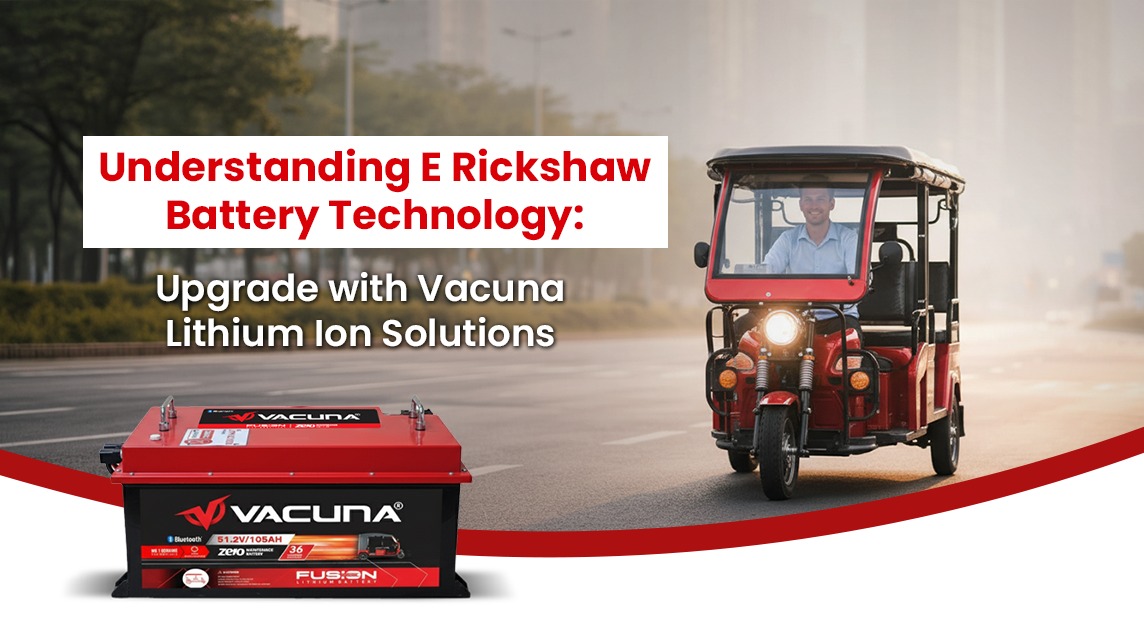
Understanding E Rickshaw Battery Technology: Upgrade with Vacuna Lithium Ion Solutions

E Rickshaws have become very common. They’re easy to run, better for the environment, and a solid way to earn daily income. But here’s the thing most people don’t talk about enough, your battery choice can make or break your experience. A lot of drivers are now switching to a Lithium Ion Battery for E Rickshaw, and honestly, it just makes life easier. Faster charging, longer life, and way less maintenance. Let’s walk through it like we’re just chatting.

Key Components of E Rickshaw Battery Technology

1. Battery Types

You’ve probably heard of lead acid, tubular, and lithium ion batteries.

Lead acid batteries are cheaper when you buy them, but they need more care and don’t last that long. Lithium ion batteries cost more at the start, but they save you money later. If you’re tired of frequent replacements and maintenance, a Lithium Ion Battery for E Rickshaw feels like a big upgrade.

2. Battery Capacity

This one’s easy. The battery capacity determines how far you can travel on a single charge.

If you are driving for the whole day, you don’t want to be stopping for a recharge. Vacuna batteries are designed for constant performance so you can keep on driving without worrying about a thing.

3. Charging Time

Time is money, especially if your business is your vehicle.

Old batteries take almost the whole day to recharge. That’s a waste of time, not to mention money. A Lithium Ion Battery for E Rickshaw takes a fraction of the day, so you can get back on the road and earning faster.

4. Durability and Maintenance

Let’s be real, nobody enjoys checking water levels or dealing with battery issues every few days.

That’s where lithium ion really stands out. No regular maintenance, no extra effort. Vacuna batteries are built tough, so they can handle daily use without giving you trouble.

5. Eco Friendly

If you’re already driving an e rickshaw, you’re doing your part for cleaner transport. Lithium ion batteries take it a step further. They’re more efficient and better for the environment.

Vacuna Lithium Ion Battery for E Rickshaw: A Smarter Choice

Vacuna gets what drivers actually need. Their Lithium Ion Battery for E Rickshaw is designed to make your work smoother and more reliable.

Key Features of Vacuna Batteries

High Mileage Performance

You can travel more on a single charge, which means more rides and better daily income.

Fast Charging

Less waiting around, more time driving. Simple as that.

Zero Maintenance

No water topping, no regular servicing. Just charge it and go about your day.

Lightweight Design

The battery is lighter, so your vehicle runs better and feels easier to handle.

Long Life

You won’t need to replace it often, which saves you money and stress.

Eco Friendly

It’s a cleaner option that supports a greener future.

Additional Benefits

Vacuna batteries come with built in safety features that protect against overheating and overcharging. You get smooth and steady performance while driving. Whether you’re a single driver or managing multiple e rickshaws, this battery fits right in.

Why Choose Vacuna

At the end of the day, you want something dependable. Vacuna keeps things simple. Their Lithium Ion Battery for E Rickshaw is reliable, easy to use, and made for real world driving conditions.

Conclusion

So, if you are planning to upgrade, Lithium Ion Battery for E Rickshaw is the way to go. You will have more time to earn and less time to worry about the battery.

At Vacuna, you are choosing a battery that works as hard as you do.

FAQs

1. Why choose a Lithium Ion Battery for E Rickshaw?

It charges fast, lasts long, and is very easy to maintain.

2. How long does a Lithium Ion Battery last?

A Lithium Ion Battery lasts for years.

3. How long does it take for a Lithium Ion Battery to charge?

It takes about 3-5 hours for a Lithium Ion Battery to be fully charged.

4. Is a Lithium Ion Battery safe?

They come with protective features for overheating and overcharging.

Vacuna Lithium-Ion Inverter Battery: Reliable Power for Every Home

Power supply variations continue across many Indian regions. Some hours remain stable, while others change without warning. This inconsistency affects different routines like work, rest, and essential tasks, and thereby creates a steady demand for backup systems that can respond quickly and reliably. In this blog by Vacuna,a trusted  lithium ion battery manufacturer in India, we will explore how Vacuna’s lithium-ion inverter batteries provide consistent, long-lasting power for every household

Vacuna Lithium-Ion Inverter Battery

Vacuna has introduced its new lithium-ion inverter battery at a moment when expectations are shifting. Users now look for longer life, safer operation, and simpler upkeep. The new model is designed with these requirements in mind, hereby combining performance with practical usability. It also reflects a broader transition in the backup power sector, where older systems slowly give way to advanced, maintenance-free options.

Modern Design and Smarter Performance for Every Space

Across homes, offices, and shops, the shift toward lithium technology is becoming more visible. Traditional batteries remain familiar, yet they require frequent checks, longer charging time, and regular servicing. Vacuna’s new inverter battery adopts a different approach. It uses high-quality lithium cells managed by an intelligent BMS that oversees temperature, charging patterns, and safety functions. This structure, meanwhile, supports smoother and more predictable performance.

One practical benefit is the compact and lightweight design. Users often struggle with bulky batteries that occupy too much space. The newer lithium model reduces this concern, thereby offering strong power backup in a smaller footprint. Such advancements reflect the growing expertise of a leading lithium ion battery manufacturer in India, where products are shaped according to regional electricity behaviour and user expectations.

Features That Strengthen Long-Term Value

Vacuna has focused on efficiency and user comfort. Some features stand out clearly:

• Faster charging, useful for areas with brief electricity windows
• Longer backup hours for essential appliances
• Zero maintenance needs throughout its lifespan
• Built-in protection against overcharging and deep discharge
• A lighter structure that is easier to place indoors
• Compatibility with newer inverter systems

As reliance on electronic devices increases, these features further support everyday routines. A trusted lithium ion battery manufacturer in India ensures that such systems are prepared for frequent usage, temperature variations, and inconsistent grid supply.

Financial Efficiency Over the Years

While the initial investment in lithium batteries may seem higher, their long-term behaviour tells a different story. They operate with less energy loss during charging, thereby lowering electricity consumption. They do not need water topping or repeated servicing, which in turn reduces maintenance cost. Their lifespan extends across more cycles, offering steady performance for several years.

Vacuna’s new model follows the same pattern, providing consistent output even after extended use. For households, workplaces, and small commercial units, this reliability becomes a meaningful advantage. These qualities reflect the technical knowledge of an experienced lithium ion battery manufacturer in India, especially in creating products suited for long-term and high-frequency operation.

Supporting Modern Digital and Practical Needs

Today’s homes depend heavily on uninterrupted power for communication, study, work, and entertainment. Sensitive devices like computers and medical equipment function better when backed by stable voltage. Lithium inverter batteries support such requirements by offering smoother transitions when the power supply drops. Meanwhile, their efficient energy storage helps reduce wastage, thereby contributing to broader sustainability efforts.

Conclusion

Vacuna’s lithium-ion inverter battery enters the market at a time when dependable backup power has become essential rather than optional. With higher energy demands and changing user habits, the shift toward advanced lithium technology appears both timely and practical. The product offers a balanced mix of durability, safety, and consistency- qualities supported by a capable lithium ion battery manufacturer in India. Users looking for a more dependable system may hereby find this solution suitable for today’s and tomorrow’s power needs.

FAQs

1. How long does a Vacuna lithium-ion battery last?

It provides reliable backup for several years, with multiple charge-discharge cycles depending on usage.

2. Is it safe for sensitive devices like computers and medical equipment?

Yes. The intelligent BMS keeps voltage stable and protects devices from overcharging or sudden drops.

3. Does it require regular maintenance?

No. Vacuna lithium-ion batteries are maintenance-free, unlike traditional lead-acid options.

4. Can it handle frequent power outages?

Yes. These batteries are designed for repeated use and perform reliably even with inconsistent electricity supply.

5. Where can I buy Vacuna batteries?

They are available through authorized dealers and online platforms. Visit the official Vacuna website to find a dealer near you.

Why Tubular Batteries Are Superior to Flat Plate Batteries

In the power-thirsty modern world, dependable energy storage is no longer a luxury—it is a requirement. For households, workplaces, or solar panels, the battery technology you choose dictates how well you can ride through outages, take on heavy loads, and stay cost-effective over the long term.

Of the options available, tubular batteries have always outperformed flat-plate batteries. At Vacuna Batteries, we put money into high-tech tubular technology because it provides the strength, performance, and endurance that contemporary users expect. Here’s why tubular batteries make sense.

  1. Designed for Strength and Durability

Flat-plate batteries have thin plates of lead, which are more susceptible to corrosion and shedding with the passage of time. Tubular batteries, however, employ rugged tubular positive plates with a polyester gauntlet jacket. It maintains the integrity of the active material, significantly minimizing wear and tear. This produces a battery that can last for years on end with little decline in performance, even under harsh operating conditions.

  1. Longer Service Life and More Charge Cycles

Another critical consideration when shopping for batteries is their longevity. Flat-plate batteries typically are good for a shorter lifespan and fewer discharge-recharge cycles, and hence are optimal for short-term or light backup.

Tubular batteries are made for deep cycle functionality—they can withstand repeated and extended power cuts without compromising their efficiency. In reality, tubular models come with thousands of cycles at a safe depth of discharge, which gives years of consistent delivery. For the consumer, this means less replacement and reduced long-term expenses.

  1. Better Performance When There Are Power Cuts

Regular outages are a norm in most areas, and that’s when tubular batteries excel. Their heavier plates and superior build make them last longer as backup batteries than flat-plate batteries. They further ensure that voltage is consistent, and appliances and electronics move without variations.

Flat-plate batteries tend to drain more quickly during load, and therefore they are less reliable for longer blackouts. Tubular technology allows households and companies to benefit from seamless comfort and productivity.

  1. Improved Resistance to Deep Discharge

Deep discharge is among the most frequent causes of premature battery failure. Flat-plate batteries are designed not to withstand repeated deep discharge, resulting in rapid plate degradation and lower capacity.

The tubular batteries are engineered specifically for this issue. They can tolerate a depth of discharge of up to 80% without suffering any loss of active material. This makes them a highly suitable choice for regions that experience long and frequent power outages, or solar usage with higher discharge cycles on a daily basis.

  1. Low Maintenance and Hassle-Free Operation

Flat-plate batteries usually need frequent water top-ups since they use a larger amount of electrolyte during charging and discharging. Failure to attend to this maintenance will leave them drying up fast.

Tubular batteries use water at a far lower rate. Efficient design minimizes evaporation and maximizes intervals between refilling. For the user, that translates into less effort, less vigilance, and more confidence. In our tubular products, Vacuna Batteries are aimed at providing easy maintenance and consistent day-to-day performance.

  1. High Temperature Resistance and Climate Readiness

The Indian subcontinent, the Middle East, and Africa are vulnerable to high temperatures, which have a direct impact on the efficiency of batteries. Flat-plate batteries tend to overheat, corrode, and lose water under these conditions.

Tubular batteries are less vulnerable to ambient high temperatures. They have an open structure and better circulation of the electrolyte, which reduces heat accumulation, and thus they are more stable and reliable in tropical and semi-tropical areas. This is even beneficial in solar applications where batteries have to survive outdoor conditions.

  1. Long-Term Cost-Effectiveness

On the surface, flat-plate batteries appear to be cost-effective initially at the time of purchase. However, if you take into account their shorter lifespan, higher maintenance needs, and more frequent replacement, they cost more in the long run.

Tubular batteries require a little more upfront cost, but their long lifespan, low maintenance, and high efficiency make them significantly more cost-effective. Companies and homeowners both save money by not needing to replace batteries every few years, making tubular technology the smart financial choice.

Conclusion

While flat-plate batteries are still sufficient for low-load, short-duration backup, they do not possess the performance, durability, and ruggedness of tubular batteries. Vacuna Batteries strongly recommend the use of tubular batteries because they are engineered for long life, deep discharge, thermal stability, and stable output—all the qualities which consumers of today demand.

For homes, offices, and solar systems in need of round-the-clock, reliable power, tubular batteries are not only an improved choice—they are the only choice for those who desire peace of mind and money’s worth.

At Vacuna Batteries, you don’t merely purchase a product—you make a long-term energy investment made for today’s requirements and tomorrow’s demands.

Vacuna Inverter Batteries: Powering the Middle East with Long-Lasting Solutions

As the Middle East expands at a blistering rate, with technological innovations, the demand for reliable and long-lasting energy solutions has never been more critical. The varied climatic conditions of the Middle East and industrialization in countries such as Afghanistan, Syria, UAE, Iraq, Oman, Yemen, Turkey, and Lebanon require high-power systems with the capability to meet swinging power requirements. Vacuna Inverter Batteries are designed to meet these challenges head on, with an eco-friendly and efficient power solution for both commercial and residential use.

The Rising Demand for Inverter Batteries in the Middle East

The Middle Eastern region, where temperatures are hot, summer days are long, and there are frequent power outages, places enormous strain on conventional power systems. Commercial energy reliability is a top concern for businesses, particularly those involved in manufacturing, telecommunication, and healthcare. There is a growing need for high-performance inverter batteries due to the demand for uninterrupted power supply (UPS) systems.

Vacuna inverter batteries are ideal for such an arrangement, providing a reliable back-up source of power that can keep things going even in adverse conditions. They are outstanding in power supply even in those areas with frequent power outages and voltage fluctuations.

Key Features of Vacuna Inverter Batteries

  1. Long-Term Performance

Vacuna inverter batteries are made to last for a long time, providing users in nations such as Iraq and Afghanistan, where power is often cut off, a stable source of energy. With a long lifespan and little in terms of maintenance requirements, the batteries are made to last, which saves homeowners and businesses money down the line.

  1. High Efficiency and Low Maintenance

Due to the fact that the batteries stored energy with very minimal losses in the process of converting power to energy, one of the key advantages of Vacuna inverter batteries is their high efficiency of energy consumption. This is accompanied by minimal maintenance, making it an ideal solution for those places where technical expertise and facilities may be limited, such as Yemen or Syria.

  1. Quite Suitable for Extreme Weather Conditions

Extreme weather conditions are what define the Middle East, especially during summer when temperatures usually go high. Vacuna inverter batteries are very compatible with high-temperature operations, guaranteeing utmost reliability in the harsh heat.

  1. Advanced Technology

Vacuna batteries offer the most advanced battery technology available, giving optimum performance and life. The special deep discharge feature and quick charging capability ensure that they are top of the list for Turkish, Lebanese, and UAE buyers, where energy saving tops their list.

Why Choose Vacuna Inverter Batteries for Export to the Middle East?

  1. Global Accessibility and Reach

Vacuna inverters’ batteries are shipped to other Middle East nations, including the UAE, Iraq, and Syria. Since there is a growing need for high-quality power solutions in these nations, Vacuna keeps its products readily available for importers and distributors across the Middle East.

  1. Affordable Power Solution

With continually rising energy costs in much of the Middle East, the security of owning a backup power source like Vacuna inverter batteries is more than worth the cost. The batteries offer an excellent return on investment, saving businesses and homeowners money through reduced reliance on the grid.

  1. Support and Service

Vacuna as a trusted brand offers better customer support and service to Middle Eastern customers. Distributors and importers can depend on timely support and technical help during installation, maintenance, and repairing to make business easier for businesses in Turkey and Yemen to incorporate Vacuna batteries in their operations.

Conclusion

As the Middle East grows and develops at an increasingly fast rate, Vacuna inverter batteries are increasingly indispensable to the energy composition of the region. From scorching heat to unreliable power grids, Vacuna inverter batteries offer an affordable, stable, and environmentally friendly solution for balancing the varied energy demands of nations such as Afghanistan, Iraq, Lebanon, and more.

Whether you are a distributor, an importer, or a company seeking a power backup that you can rely on, Vacuna inverter batteries offer unparalleled performance and reliability. With Vacuna, you’re building a future of reliable, long-term energy to keep homes and businesses running smoothly and reliably.