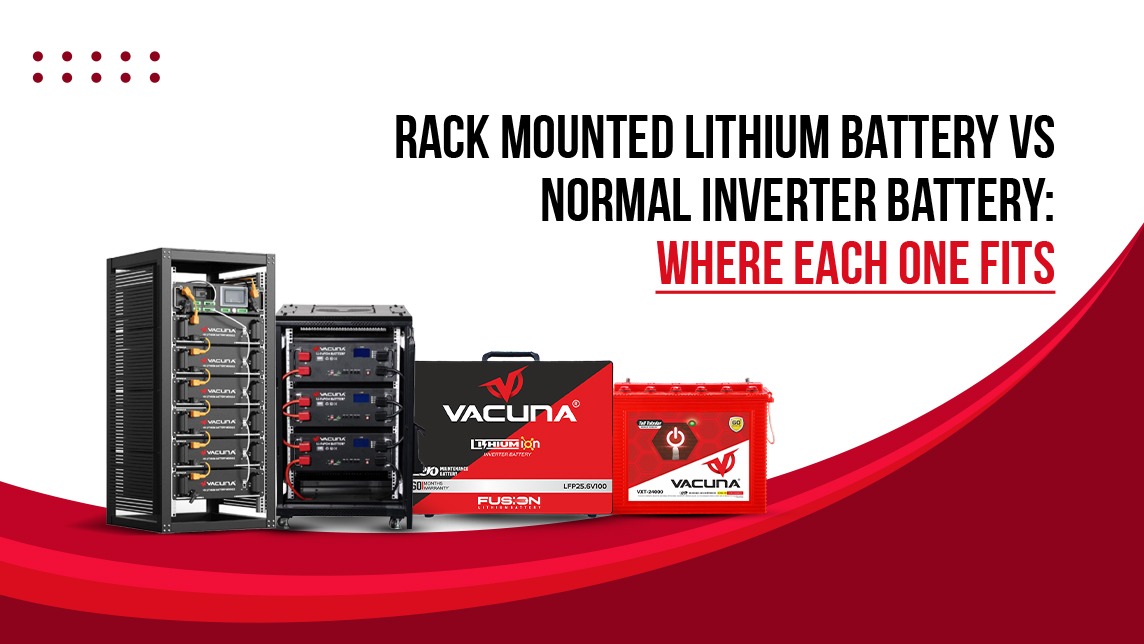
A normal inverter battery is enough for many homes.
Lights, fans, Wi-Fi, TV, and basic backup — it can handle these if the battery and inverter are matched properly.
But once the backup need becomes cleaner, heavier, or more business-critical, the normal setup starts showing its limits. Wires get messy. Battery space becomes an issue. Charging takes time. Maintenance becomes a regular job. And if the setup is used for office systems or UPS backup, the risk becomes bigger.
That is where a Rack Mounted Lithium Battery makes more sense.
Both options have their place. The point is not that one is good and the other is bad. The real question is: where will the battery be used?
Where A Normal Inverter Battery Works Well
A normal inverter battery works best for basic backup.
For a home, small shop, or small office, it can support daily power cuts if the load is not too heavy. If the main need is lights, fans, router, and a few small devices, this setup is usually simple and practical.
It is also easier for users who want a familiar system and do not need rack-based installation.
But the battery must be sized properly. If the load keeps increasing, backup drops. If ventilation is poor, battery life suffers. If charging is not proper, performance goes down.
So even a simple inverter battery needs correct selection.
Where A Rack Mounted Lithium Battery Fits Better
A Rack Mounted Lithium Battery is better for places where backup has to be organised and dependable.
Think about server rooms, offices, clinics, CCTV rooms, institutions, telecom spaces, and commercial UPS setups. These places do not only need backup. They need clean installation, better space use, faster charging, lower maintenance, and stable power support.
A rack-mounted setup also looks cleaner. Batteries are not lying around in corners. Wiring is easier to manage. The setup can be planned properly.
For business users, this matters.
When power goes off, the system should not become a guesswork game.
Why Lithium Helps In Critical Backup
Lithium batteries solve some daily problems that many users face with older setups.
They charge faster. They need less routine maintenance. They take less space. They also give better usable power when matched correctly with the inverter or UPS system.
For a commercial user, this is useful.
A clinic cannot afford system shutdowns during working hours. A server room needs steady backup. A shop needs billing, CCTV, and internet to stay active. An office needs routers, laptops, and access systems running during outages.
In these cases, a Rack Mounted Lithium Battery can be a better fit than a basic battery setup.
Normal Backup Or Rack Setup: How To Decide
Start with the load.
If the backup is only for home comfort, a normal inverter battery may be enough. If the backup supports important work, customer service, systems, or data, plan more carefully.
Also check space.
If the battery area is already crowded, a rack setup can make the system neater. If future expansion is likely, rack-mounted lithium gives better planning.
Then check the equipment.
A Lithium Ion Battery for Inverter may work well for home and light commercial use. A lithium battery for UPS may suit offices, clinics, and IT setups. A Lithium Battery Inverter setup may be useful where users want a more compact and modern backup system.
The right choice depends on load, runtime, site space, charging source, and future use.
What Buyers Should Check Before Installing
Do not buy a battery only by capacity.
Check these points first:
What load needs backup?
How long should the backup run?
Is it for inverter, UPS, or solar storage?
Is rack space available?
Does the system need future expansion?
Is service support available?
Does the battery have proper BMS protection?
For buyers looking at a lithium battery inverter in India, this step is important. The battery, inverter, charger, and load should work together. If one part is mismatched, the full system suffers.
Where Vacuna Fits In
At Vacuna, the focus is on practical battery selection.
A home user does not need the same setup as a server room. A clinic does not need the same backup as a small shop. A UPS room does not work like a regular home inverter corner.
That is why battery choice should begin with the actual use.
For clean commercial backup, a Rack Mounted Lithium Battery gives a more organised option. For simpler backup, a normal inverter battery may still be enough.
Final Thoughts
A normal inverter battery is useful for basic backup.
A Rack Mounted Lithium Battery is better when backup becomes more serious, organised, and space-sensitive.
The choice should not be made only by price. It should be made by looking at load, space, charging time, maintenance, safety, and how important the backup is.
If the power cut only causes discomfort, a basic setup may work.
But if the power cut stops work, billing, data, security, or patient handling, the backup system needs better planning.