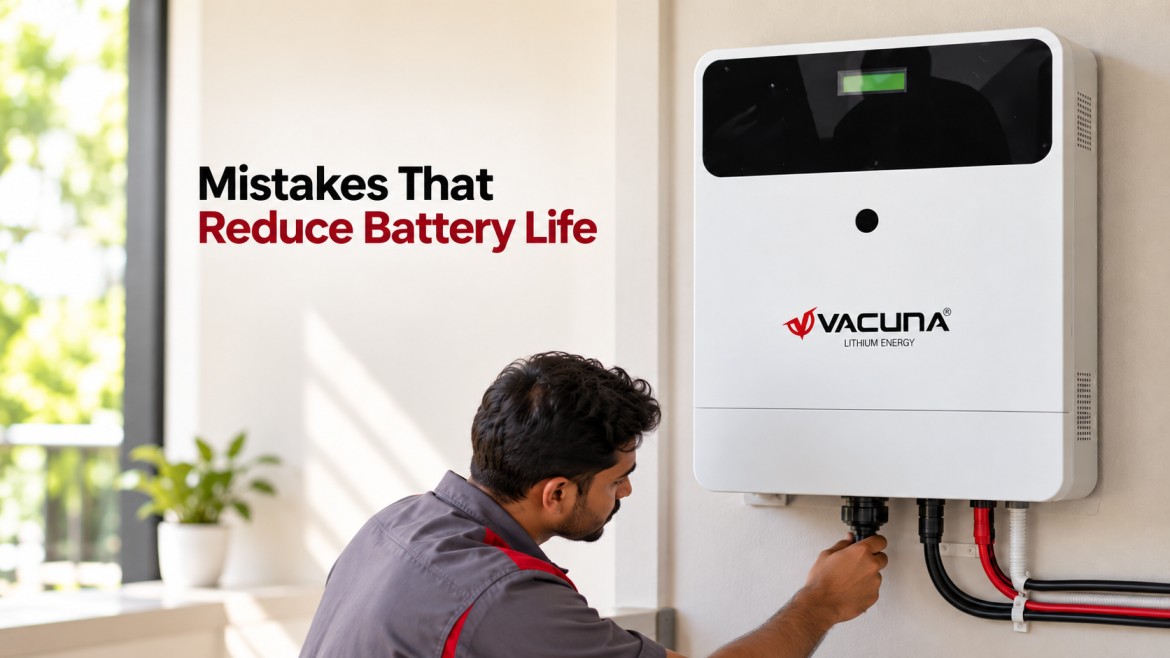
The Lithium Battery Inverter is able to give a very reliable power source for several years if the battery, the inverter, the charger, and the load cooperate properly. However, even in case of a good lithium battery, there might be some performance issues due to the fact that some installation rules are ignored by users. The point is that these flaws will not result in the battery failure at once but charging process might slow down or backup period might decrease.
It is worth mentioning that lithium batteries require less routine care than conventional lead-acid batteries. This does not mean that they can be installed everywhere, can be charged with any charger, or can be used without control of the whole system. Some measures might really matter.
1. Using The Wrong Charger
An error that comes in quite handy is where one tries to charge the battery using a charger that is incompatible with the battery.
Lithium batteries have their own specific requirements for the charger. The voltage capacity of the charger and its specifications must be appropriate to ensure proper charging of the battery.
This is equally the case with a lithium battery and inverter connection. The inverter has to support the chemistry of the lithium battery as well as its charging specifications.
Before connecting the battery, make sure you know its specifications such as battery voltage, charging voltage, charging current and even inverter specifications. It should not be assumed that a particular charger will function for another battery.
For all people working with Lithium Battery Inverter system, it is important to establish compatibility before charging the battery.
2. Installing The Battery Without Checking The Location
Although lithium batteries are not always as demanding as traditional batteries in terms of regular maintenance, the place where they are installed is still an important factor.
The battery cannot be installed in the place which is exposed to too much heat, water, sunlight, or dust. The installation site must also ensure proper ventilation and protection from any possible damage.
Insufficient space and the lack of proper access to the battery can complicate servicing and inspection of the battery. This installation place can create an unfavorable environment for the battery and other devices connected to it.
The place where the battery should be installed must be chosen before its purchase.
3. Ignoring Extreme Temperatures
Temperature is yet another factor that users often ignore.
Extremely high temperatures can cause some damage to the battery and shorten its lifespan. On the other hand, extremely low temperatures can also affect the battery in terms of charging and overall function.
This does not imply that the battery will require a separate room in each installation. It simply indicates that the battery will work in the temperature range recommended for that particular battery.
In residential, office, shop, or commercial setups, do not keep the battery near any heat-generating machines or in places that get very hot throughout the day.
The above-mentioned principle also applies to the Lithium Battery UPS Application. In the case of a UPS room or equipment room, the environment should be appropriate for the whole backup system.
4. Overloading The Backup System
A bigger battery doesn’t necessarily mean users can hook up as many appliances as they want.
Each back-up system comes with its own capacity. Putting extra load on your system will put strain on your inverter and battery and can shorten the amount of backup time you were expecting to get.
For instance, the user might have started using the battery for fans, light bulbs, Wi-Fi, and some other devices. Then, at some point later, he/she hooked up his/her refrigerator, television, computer, and so on without thinking about the total load.
This causes the battery to appear to provide less back-up.
However, the actual issue is probably just high energy usage.
Make sure to calculate your total power consumption before adding any extra load. Make sure that your appliances should be running or not during a power outage.
5. Using The Battery With An Incompatible Inverter
Lithium battery and inverter need to be considered a unified backup unit.
Voltage level is not the only factor of compatibility. Other factors like charging current, battery settings, communication abilities, and protection needs may need to be considered for different battery and inverter models.
The battery can operate with the inverter successfully at the beginning but will still fail to provide required charging/backup efficiency due to system settings incompatibility.
It is especially true for cases when lead-acid batteries are replaced with lithium ones. Do not assume that your old inverter is compatible with the new battery.
Make sure to verify compatibility recommendations by manufacturer before switching the battery type.
6. Ignoring The Battery Management System
Many lithium-ion batteries come with a Battery Management System, which is usually referred to as a BMS. It is an aid in monitoring and safeguarding the battery by controlling such elements as voltage, current, and temperature.
Nevertheless, this system does not become a reason to neglect other components of the battery system.
In case if the battery continuously reaches its protection limits, users need to find out the reason behind this. Constant alarms, shutdowns, and strange temperature conditions cannot just be overlooked.
7. Poor Wiring And Loose Connections
The battery might be in excellent condition but might give bad output due to problems with the wiring.
Such problems include loose terminal, inappropriate cables, connection issues, and wrong size cables that will affect the electricity supply from the battery to the inverter.
Connections must be checked during the installation process. The cable size must suit the requirements and the terminals must be tight.
If users observe that there is heating around the connection, an unpleasant odor, damaged connections, or there are frequent power outages, the system needs to be checked by a qualified person.
Do not keep on turning on and off the inverter to fix an electrical connection problem.
8. Storing The Battery Incorrectly
Every lithium battery does not always stay permanently connected to the system. There are some batteries that might be stored before the installation or held as a reserve by the dealer.
This is something to consider.
It is essential to follow the instructions of the manufacturer for the recommended charging level, temperature, and duration of storage. The battery must be stored in a dry place.
For the dealers working with a Lithium Battery for UPS, proper warehouse storage is particularly crucial since the batteries can stay in stock before they reach the consumer.
9. Waiting Until There Is A Problem
Most people would tend to observe the battery when the backup gets poor.
This may make it difficult to notice a smaller problem.
It is better to be conscious of any abnormalities in the routine performance.
A longer charging process, frequent shut-downs, alarm, lack of backup, abnormal heat, or even damage should raise a red flag.
Periodic observations should not necessarily be complex.
Observing the inverter screen, observing the visible connections, or using the battery monitoring system when available will do the trick.
The problem may turn out to be a simple installation or usage problem.
How To Get Better Life From A Lithium Battery
It’s actually very simple. Just use the proper charger, choose the correct inverter for your battery, keep within the range of loading, have the proper installation environment, and of course follow all the instructions of the manufacturer.
It helps to know your real power needs as well. The right battery for the load will always work better than just choosing a battery based on its Ah rating.
For companies with a Lithium Battery Inverter, knowing your power needs becomes especially vital since the power needs may change throughout the day.
At Vacuna, we specialize in lithium batteries, and we do our best to ensure a backup solution for inverter and UPS systems. Choosing the right battery is just one of many ways to achieve great results.
Final Thoughts
Even though Lithium batteries are made to minimize maintenance, these batteries are not maintenance-free.
Incorrect charging, improper installation, exposure to harsh conditions, overload, or lack of compatibility may influence their performance. Bad wiring and improper storage may lead to further complications.
However, most of these errors can be avoided.
While selecting a Lithium Battery Inverter, the whole system should be considered rather than just the battery itself.
The battery should be selected according to the inverter, charger, load, and installation conditions. After that, the instructions of the manufacturer should be followed concerning operation and storage.
Long battery life is not dependent on one element.
Long battery life is achieved through proper use of the whole system.
Frequently Asked Questions
1. Does A Lithium Battery Need Regular Maintenance?
Lithium batteries usually need less routine maintenance than traditional lead-acid batteries. However, users should still check connections, charging behaviour, temperature, and overall system performance.
2. Can I Use Any Inverter With A Lithium Battery?
No. The inverter should support the battery’s voltage, charging requirements, and other compatibility requirements. Always check the manufacturer’s recommendations before installation.
3. Can Heat Reduce Lithium Battery Life?
Yes. Excessive heat can affect battery performance and may reduce its useful life. Install the battery in a suitable location within the manufacturer’s recommended temperature range.
4. Why Is The Correct Charger Important?
A suitable charger provides the required voltage and current for the battery. An unsuitable charger may cause slow, incomplete, or improper charging.
5. Is A Lithium Battery For UPS Better Than A Traditional Battery?
A Lithium Battery for UPS can offer advantages such as lower routine maintenance and longer service life in suitable applications. The right choice depends on the UPS, load, operating conditions, and required backup.
6. How Can I Make My Lithium Battery Last Longer?
Use a compatible inverter and charger, avoid excessive loads, maintain suitable operating temperatures, keep connections secure, and follow the manufacturer’s charging, installation, and storage instructions.