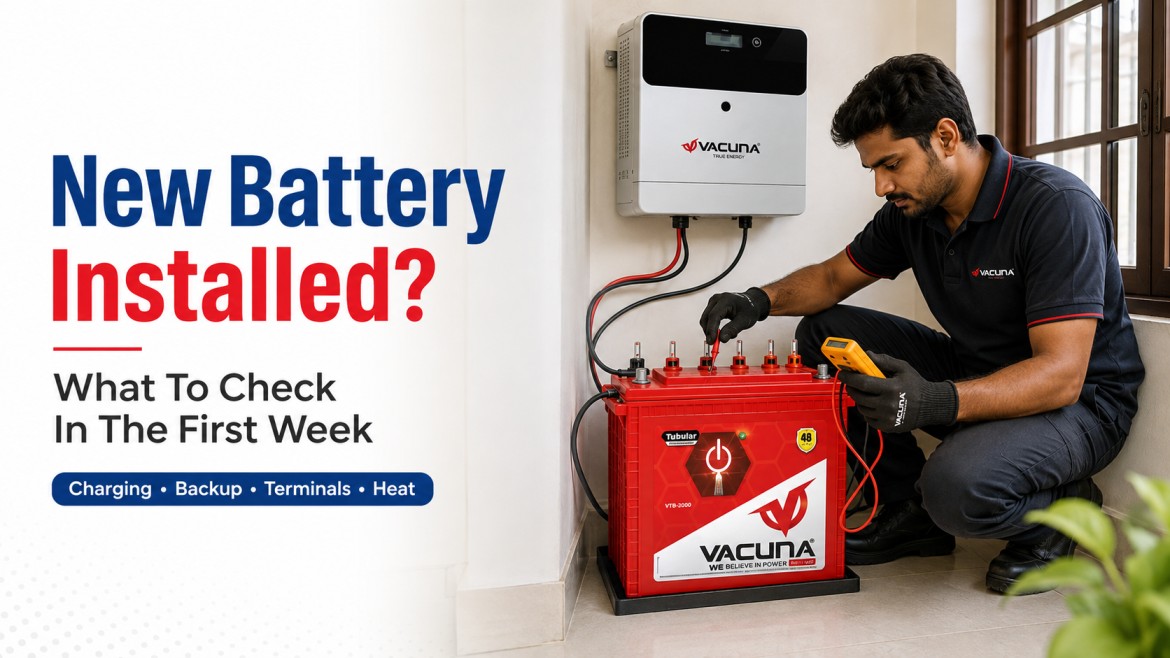
The performance of the new battery is normally assessed within the first 24 hours. There is power generation by the inverter, the car starts, or there is backup, everything seems all right. However, the first week is an indication of whether the battery, charger, wiring, and the load are working properly together. A reputable Battery Manufacturer in India would consider not just the ability of the battery to supply power to the system but also charging behavior, backup period, terminals, heat, and daily use as well.
Day One: Check The Installation First
The first test is pretty straightforward – did the battery install well?
All terminals must be clean and tight. The cables must not be loose, and the battery must be tightly secured in its designated position. For an Inverter Battery, it must also be dry and ventilated well.
No matter how healthy the battery is, it may underperform due to loose connection. This is the reason why installation is to be tested before making any conclusions regarding its performance.
For an Automotive Battery, the terminals must not move while the car is going through the rough road.
Watch How The Battery Charges
What follows this is charging.
When using inverters, check the time taken to recharge the battery after the power failure. If you find that the time taken is very long, then the problem could be in the settings of the inverter, the charger, the wiring, or lack of sufficient electricity from the mains.
In case of an inverter battery, a new one needs to be installed with the appropriate inverter. Increasing the battery will not do any good if the inverter cannot charge the battery effectively.
Similar concept applies in case of automotive batteries. Here, the automotive battery relies on the charging system of the vehicle. The alternator should be strong enough to charge the battery.
A responsible battery manufacturer in India looks at charging as part of the entire system.
Do Not Judge Backup From One Power Cut
An evening’s worth of backup is insufficient for assessing the performance of a new battery.
Consider an initial outage of 30 minutes where the house was running two fans and three lights. On the second day, there is an outage lasting three hours, with the TV, Wi-Fi connection, laptop and additional fans working.
It is clear that the experience of the backup would vary.
It is necessary to keep track of the load and backup time for the first week. Ideally, it should be possible to know what appliances were being used at the time of each outage. It provides a more helpful insight than merely stating, “The battery has a reduced backup time today.”
A reputable Battery Manufacturer in India should guide their customers to understand that the backup depends on the load and the charge level.
Pay Attention To Unusual Heat
Some heating during charging or heavy usage is possible. Nonetheless, any abnormal heating should never be overlooked.
It is necessary to determine whether the battery, the cables, or the terminals have become considerably overheated. Overheating could be an indicator of loose connections, improper charging conditions, overload, or even some other system failure.
Trying to resolve this issue through setting adjustments without any professional advice would only lead to complications.
In particular, this step needs to be taken during the first week since early detection of a minor installation problem could help to prevent future complaints.
Look At The Terminals Again After A Few Days
Although everything may seem perfectly installed on the first day, it is important to check it several days later.
Movements, vibrations, or the fact that some connections were loose at first may only become obvious after use. In the case of Automotive Battery, vibration caused by the road makes it especially important. If this is a home backup system, make sure that the cables have not become loose and dirty.
Any corrosion, loose cables, swelling, odd smells, or frequent charging errors should be reported to the installer.
Has Your Actual Load Matched What You Planned?
This is often where most new-battery complaints start from.
The buyer purchases an Inverter Battery which was supposed to be capable of running four lights and two fans. Now, after installation, the family begins using Wi-Fi, television, CCTV cameras, laptops and many chargers in each power cut.
The battery is now being asked to do a lot more than what it was meant to do in the first place.
But before coming to a conclusion about how bad the backup has been, the comparison has to be done between the load that has been experienced and the load mentioned at the time of purchase.
What Vacuna Recommends During The First Week
At Vacuna, we feel that the first week should be devoted to analyzing the entire setup.
Observe how the battery charges. See what happens when backup is done under regular load. Test the terminals and the installation area. Note any unusual heating or message warnings. In addition, ensure that the inverter or car charging system is functioning correctly too.
New batteries don’t require constant care. However, the above tests will help determine if the battery and the rest of the system complement each other.
As a Battery Manufacturer in India, Vacuna gives importance to applications, compatibility, and actual performance more than battery capacity alone.
Final Thoughts
The first day just tells you if the new battery functions properly.
The first week will tell you much more.
Battery charging time, battery backup, battery terminals, heating, load, and inverter or vehicle compatibility all give indications of whether the installation is correct. If anything seems strange, always test the entire system first before concluding that there is a problem with the new battery.
An effective battery always requires an effective setup.
Frequently Asked Questions
1. Should A New Battery Give Full Backup From Day One?
It should work correctly after proper installation, but actual backup depends on charge level, connected load, inverter compatibility, and usage conditions.
2. Why Is My New Inverter Battery Charging Slowly?
Possible reasons include low charger output, inverter settings, loose cables, limited grid time, or an unsuitable battery-inverter combination.
3. Is Heating Normal In A New Battery?
Mild warmth can occur during charging or heavy use. Unusual or excessive heat should be inspected.
4. Why Does My New Battery Give Different Backup Each Day?
The load, charging time, outage duration, and starting charge level may be different each day.
5. What Should I Check In A New Automotive Battery?
Check terminal tightness, mounting, starting performance, charging-system health, and any unusual warning signs.
6. Why Choose Vacuna As A Battery Manufacturer In India?
Vacuna focuses on matching the battery with the application, charging system, load, installation conditions, and real backup needs.