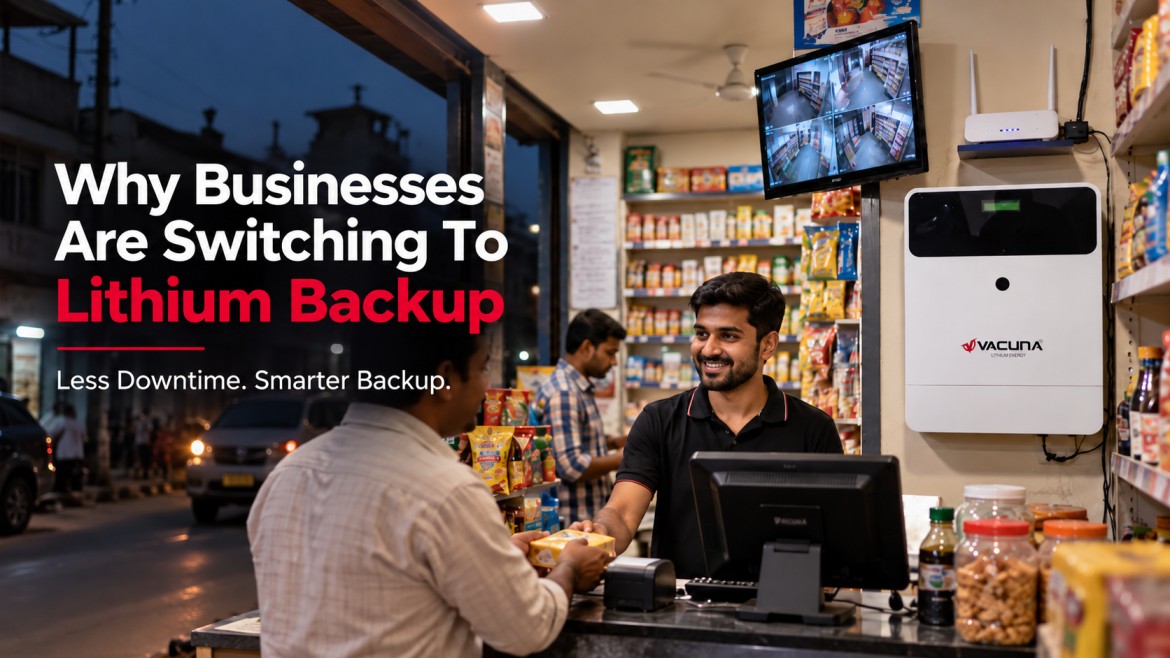
A blackout is not just about turning off the lights in a business environment. This can mean that the shop cannot use the billing machine, that the office is unable to access the internet, and that a small unit is unable to carry out any operation. Businesses that operate computers, network devices, CCTV cameras, and other vital devices would incur losses due to the brief power outage.
This is one of the reasons why businesses have begun exploring a Lithium Battery Inverter in addition to or instead of the conventional lead-acid back-up battery. This is not just about the need for better batteries but also about finding the right back-up solution.
Traditional Batteries Still Have Their Place
Backup power in the form of lead-acid batteries has been around for some time now. These batteries are common and can be very useful in many applications, provided they are appropriately chosen and maintained.
But times are changing.
A small office might experience a number of power failures within a single day. A retail store will require its billing system to be continuously operational. A business might have less room for its backup solution.
These factors become more significant in such cases.
This is not to say that every business must get rid of their old batteries straight away. It all depends on the load, the nature of operation, budget, and the required backup duration.
Why Downtime Has Become A Bigger Concern
Take the case of a small retail shop that faces a power outage.
The lights are out. The billing system is down. Internet routers are shut down. Customers have queued up, but the staff cannot make transactions as usual.
Power may come back on through the battery later, but the impact on the business has already happened.
Even an office could face this situation where computers, Wi-Fi, biometric scanners, CCTV, and many other equipment need power at all times.
For a small manufacturing or commercial entity, the costs may be even more because some machines or operations could come to a halt.
This is why companies consider backup power as a part of operational continuity and not just a safety measure.
Lithium Can Reduce Routine Maintenance
Another reason why lithium technology is considered by companies is low maintenance.
There are certain lead acid batteries that can need more maintenance, based on the type of the battery and its installation.
And this is very important for the business owner who would rather not have his employees take care of the batteries.
This makes Lithium Battery Inverter valuable when the main goal is reliable backup with low battery maintenance.
Still, “low maintenance” does not equal “maintenance-free.”
Faster Charging Can Matter After A Power Cut
It is not just a backup of energy required when the power goes out. There should also be a recharge of the battery when the electricity comes back.
Consider a store that suffers a power outage lasting two hours in the afternoon. Power comes back only for one hour, and then another power outage occurs.
If the battery has not been able to recharge itself sufficiently during that time, the next power outage starts from a lower level of reserve capacity.
Therefore, charging efficiency is essential for businesses suffering frequent power outages.
A Lithium Battery Inverter system well-matched could provide faster charging than some battery systems, depending upon the battery, inverter, charger, and installation.
This would depend upon each system and its specific components. It is not safe to assume that all lithium batteries charge at the same rate.
Space Can Also Influence The Decision
The aspect of space is often overlooked when companies consider the comparison between different types of batteries.
An office setting may have an electric section while a retail environment may have minimal space available.
A clinic, showroom, or even an office environment would appreciate the more compact and efficient nature of backup power.
Lithium batteries may have greater capacity within smaller size as compared to some conventional batteries.
But the aim should not be to choose a smaller battery.
The battery must meet the requirements in terms of power and time.
Longer Service Life Changes The Cost Calculation
Purchase price is one of the first factors customers compare.
It is only natural, but then again, it is especially true for small companies.
However, the cost at which something is purchased is just one factor to take into account. The business would do better to look at the expected lifespan, maintenance costs, how often it will have to be replaced, downtime, and other requirements for operation.
The battery whose purchase price is higher can be justified by longer operational life span and lower maintenance costs.
That is when the Lithium Battery Inverter should be considered from this point of view.
Businesses Also Need To Think About Load
Use of lithium will not work as a solution for a wrongly sized backup system.
For instance, a place that has lighting fixtures, billing machines, CCTV, fans, and network equipment needs batteries that can accommodate the load.
A business place that has computer sets, routers, printers, security gadgets, and others needs something else.
Therefore, before deciding on which system to install, business owners need to determine which devices will be running when there is a blackout and the time it will take.
It will help to avoid making a very common mistake of sizing a battery using the Ah ratings only.
What About Lithium Battery For UPS Applications?
In businesses having sensitive machinery, one can even think about using a Lithium battery in UPS.
The UPS are used in order to ensure that the critical machines continue to operate even when there is no power supply. In an office environment, network operations, security system, and many other businesses require a battery backup system which is tailor-made for them.
Lithium batteries can be quite helpful where companies require reduced maintenance, reduced space requirements, and extended lifespan of the product.
Yet compatibility is always important. Compatibility between the UPS, battery voltage, charging system, load, and battery management system needs to be ensured.
The choice of the battery should never solely be due to it being lithium.
When Does Switching To Lithium Make Sense?
Lithium backup is one of those considerations that need to be kept in mind if the organization experiences too many power outages, needs rapid charging capability, has limited space for installation, or wants to minimize maintenance costs.
In addition, it might become necessary when the current batteries are being changed too often or fail to provide backup as needed.
However, when there is no issue with the existing system, the organization does not have any concerns about space and maintenance and everything works just fine, there is no need to change anything.
It all depends on necessity.
How Vacuna Approaches Lithium Backup
In Vacuna, lithium battery systems are intended to be used in cases where energy storage is necessary and practical.
For businesses, it is important that the system is chosen based on the need for the energy storage system and not necessarily on the basis of being the latest technology out there.
A Lithium Battery Inverter can serve to be an ideal system for shops, offices, and small-scale commercial facilities taking into account all these considerations.
The battery is just one of the components of the system.
Final Thoughts
Businesses are gravitating towards lithium-based systems for practical reasons.
With minimal maintenance, quick recharge time, small space, and extended service, lithium may be the ideal choice for businesses unable to afford any disruption in their processes.
However, just because lithium may be better than other options does not mean it is always the best option for all situations.
Before considering lithium over the conventional type of battery, businesses need to assess their load, their backup needs, check their inverter’s suitability for the lithium solution, and do the cost comparison over the expected lifespan of the equipment.
If used appropriately, the Lithium Battery Inverter can present businesses with a practical solution for their backup power supply needs.
The thing is not in the battery swap; it is in getting a suitable backup system.
Frequently Asked Questions
1. Why Are Businesses Switching To Lithium Backup Batteries?
Businesses are considering lithium because of benefits such as lower routine maintenance, faster charging, compact installation, and potentially longer service life. Suitability still depends on the application.
2. Is A Lithium Battery Inverter Suitable For Shops?
Yes. A properly sized system can support essential shop loads such as lights, billing equipment, CCTV, routers, and other selected devices during power cuts.
3. Is Lithium Better Than Lead Acid For Business Backup?
Neither technology is automatically better for every business. Lithium can offer advantages in maintenance, charging, space, and service life, while lead-acid remains suitable for many applications.
4. Can A Lithium Battery Be Used With An Existing UPS?
It depends on the UPS model and battery requirements. Voltage, charging settings, communication features, and battery compatibility should be checked before making a replacement.
5. Does A Lithium Battery Need Maintenance?
Lithium batteries generally require less routine maintenance than many traditional battery systems. However, correct charging, installation, temperature, wiring, and system checks remain important.
6. How Should A Business Choose A Lithium Battery Inverter?
Start with the equipment that must run during a power cut. Calculate the load, decide the required backup time, check the inverter and battery compatibility, and then compare suitable systems based on total ownership cost rather than purchase price alone.